
Nikro Air Duct Cleaning in Wilmington: A Homeowner’s Guide
Nikro builds the portable negative-air duct cleaning systems that serious independent contractors actually buy, and knowing what that equipment does explains why “duct cleaning” can mean two very different jobs depending on who shows up. Most homeowners in Wilmington don’t need a brand lecture. They need to know what real suction looks like, what proper containment feels like, and how to tell the difference during a quote conversation before anyone touches a register. So we’ll skip the sales pitch and talk equipment, process, and the questions you should be asking.
Key Takeaways
- Nikro portable systems use HEPA-filtered, multi-stage collection, which is the tier that keeps dislodged debris out of your living space.
- Equipment brand alone doesn’t make a job good. A skilled operator with equivalent gear beats a careless one with a famous label every time.
- Ask about containment setup, filtration stage, and whether the tech verifies negative pressure before starting. The answers tell you a lot.
- If you’d rather not DIY or sort this out alone, call (855) 360-7068.
What Does “Nikro Air Duct Cleaning” Actually Mean?
Nikro air duct cleaning in Wilmington NC refers to cleaning performed with Nikro Industries’ portable negative-air collection systems, which pull dust and debris out of the ductwork while keeping it out of your living room. Nikro is a recognized name in the restoration and remediation trade, and its duct cleaning vacuums are built to hold a steady vacuum under load rather than spike briefly and fade. That distinction matters more than most homeowners realize, because a weak vacuum doesn’t clean so much as stir.
The core idea is simple. You want airflow moving toward the machine, not back into the room. A HEPA-rated collection unit with proper filtration stages traps what it pulls in, including fine particulates that would otherwise cycle right back through your supply registers. When the collection end is doing its job, the registers and returns you can see stay cleaner after the service than they were before it. When it isn’t, debris settles somewhere else in the system and the count of airborne particles barely moves.
What homeowners should know going in: the brand on the side of the machine is a starting point for a conversation, not a guarantee. Ask what filtration the machine uses, how many stages, and whether the operator confirms negative pressure at the start of the work. Those answers are checkable. If you’d like that level of detail on your own home, we’re happy to walk through it. Call (855) 360-7068 for a free estimate on air duct cleaning.
How Does a Nikro Negative-Air System Work?
A Nikro negative-air system works by creating a pressure differential: the machine pulls air and debris out of the duct system under continuous suction while a HEPA filter stage captures what it collects. The goal is to have the duct interior under slight negative pressure relative to the room, so anything dislodged travels toward the machine rather than into the room you’re standing in. In plain terms, the system is the exhaust end of a two-part job. A technician agitates the dust, brushes, and loosened material at the register or trunk line, and the collection machine handles what gets kicked up.
Two technical ideas are worth understanding because they separate real cleaning from show cleaning. The first is source removal versus air wash. Source removal means physically loosening and extracting the accumulated material from the duct surfaces. Air wash means blowing air around in the system and hoping it does something. A Nikro machine can support source removal beautifully, but it doesn’t do it alone. That job also needs agitation tools working the surfaces. Some systems are advertised as air-wash cleaning, and if you hear that term, ask exactly what agitation and extraction are being used. In our experience, most complaints about “the ducts didn’t look any different after” come from air-wash jobs sold as source removal.
The second idea is CFM and static pressure. CFM stands for cubic feet per minute, essentially how much air the machine moves. Static pressure tells you how much resistance the machine can push through – a long duct run with tight bends, or a system with a lot of flexible line, creates more resistance than an open trunk. A machine rated for high CFM on a clean filter can fall off on a dirty one, so the operator’s maintenance practice matters as much as the spec sheet. If the filters haven’t been changed in a long time, the machine is working against itself.
- Negative pressure – the room-side air should be pulling toward the machine, not toward you.
- HEPA filtration – a filter stage rated to capture fine particles, not just visible dust.
- Source removal – agitation tools loosen debris, extraction removes it, and neither replaces the other.
- CFM vs. static pressure – high airflow numbers mean little if the machine can’t overcome the system’s resistance.
Portable Negative-Air vs. Truck-Mount vs. Shop-Vac: What’s the Real Difference?
Portable negative-air systems like Nikro units sit between a truck-mount vacuum and a shop vac, and the gap between those tiers shows up in three metrics that actually matter: static pressure, HEPA filtration, and containment of dislodged debris. A truck-mount unit typically has a bigger blower and more raw airflow because it’s bolted to a vehicle, but it also requires running a heavy hose into the house and, on some setups, struggles to hold pressure over a long run. A shop vac, even a large one, has limited filtration, limited static pressure, and no meaningful HEPA stage. If a technician shows up with only a shop vac and a rotary tool, you’re getting a surface-level job.
Here’s how the comparison usually breaks down:
- Truck-mount – high raw airflow, but less flexible in homes that need multiple simultaneous access points, and containment depends heavily on how the hose and access ports are sealed.
- Nikro portable negative-air – purpose-built HEPA filtration, decent static pressure for the typical residential system, and easier containment setup at each room because the machine can be positioned where the work is happening.
- Shop vac – low airflow, weak filtration, and virtually no containment. Fine dust tends to come back out of the exhaust, which means it ends up in your home.
What’s checkable during a quote: ask what happens to the exhaust from the machine. Ask where the collection unit sits during the cleaning. Ask whether a HEPA stage is part of the setup or an add-on. A crew that knows its equipment will answer without hesitation. One that doesn’t will say something vague about “special equipment.” That pause is your cue to ask more questions or find a different provider. If you’d like to talk through the equipment before booking, we can do that by phone. Call (855) 360-7068 for a free estimate on Wilmington duct cleaning.
What Does a Nikro-Based Service Call Look Like Step by Step?
A properly run Nikro-based cleaning follows the same sequence every time, and knowing the steps lets you spot a shortcut from across the room. Before any cleaning starts, the technician should walk the system with you – identify all registers, returns, and the air handler. That inspection is also where you’ll hear about flexible duct that’s already sagging or a joint that has come apart. It’s better to find that before the vacuum starts.
- 1
Access point cutting and sealing. The technician identifies locations along the trunk and branches where access holes will be cut, then cuts them cleanly and seals them with a proper cover afterward. Once the machine is connected, those openings become sealed ports. If a crew is cutting large ragged openings without sealing plans, that’s a flag.
- 2
Containment and negative pressure verification. Equipment such as Abatement Technologies negative-air machines helps establish proper containment when cleaning one zone at a time. Before moving to cleaning, the technician should confirm the system is pulling in the right direction. Some crews use a smoke pencil; others check with a handheld pressure gauge. Either is fine. Neither is fine to skip.
- 3
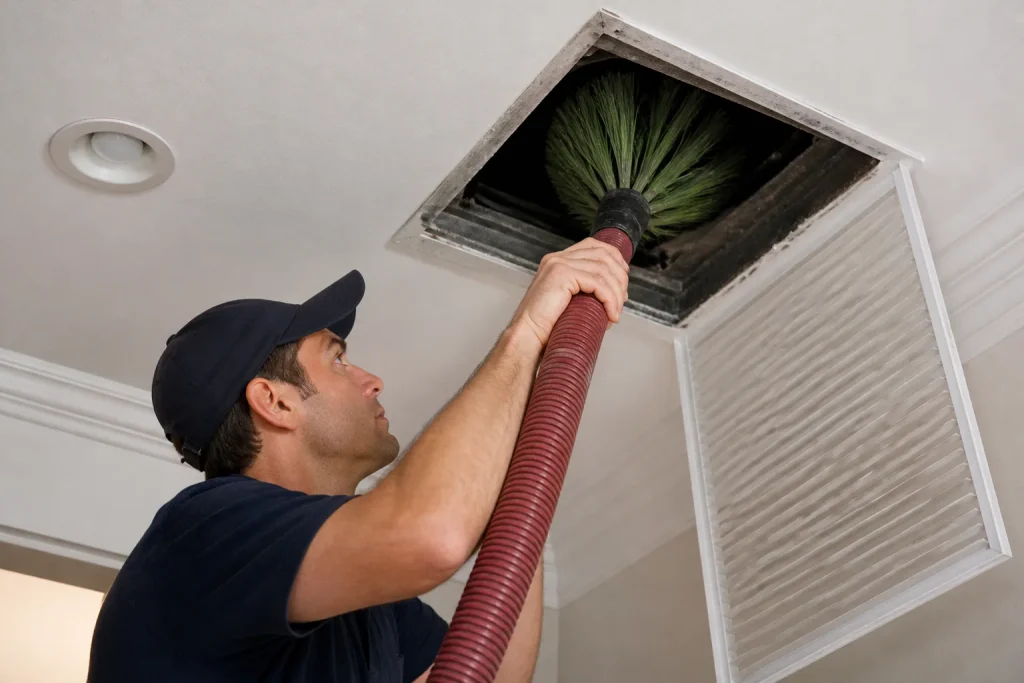
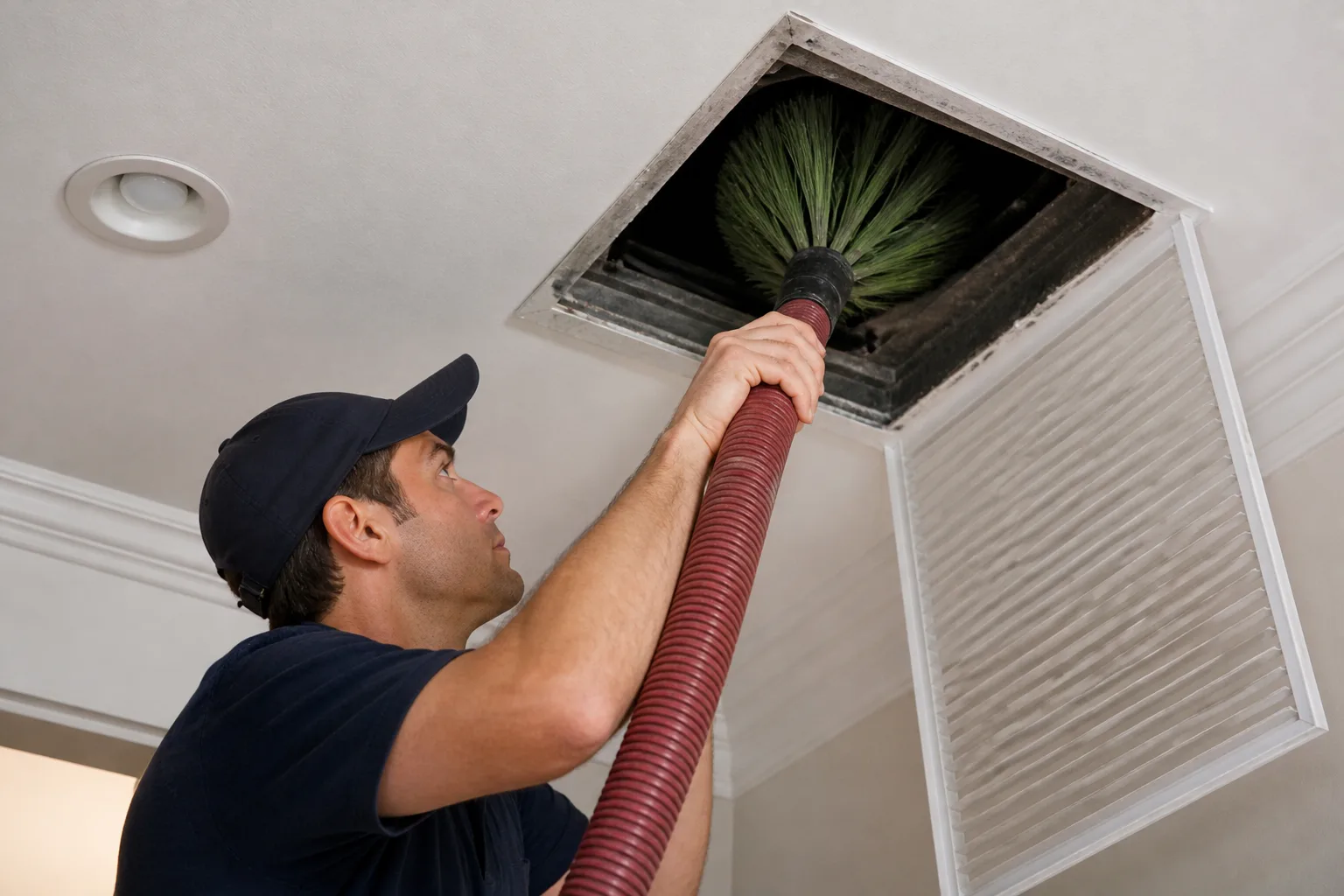
Register-by-register agitation. At each supply and return, the tech uses the appropriate tool for what’s in that run. Rotary brush systems like the Rotobrush are standard for rigid metal duct. Compressed air whips work better in certain flexible runs. A soft-bristled attachment gets used where the duct can’t take a brush. Then suction collects what loosens. Every register gets its own pass. Skipping registers to save time undermines the whole job.
- 4
Verification and reset. Once cleaning finishes, the machine comes off, access covers go on, and the technician should walk the system again to confirm nothing was left open. Some crews use the before-and-after photos at this point. That’s a fair ask on your part.
Wilmington homes tend to run a mix of duct types – newer construction with flexible branches off a centralized system, older homes with rigid metal trunk lines, and a wide middle where both coexist. A crew set up for one duct type and caught off guard by another will visibly slow down. The right equipment and the right accessories need to be on the truck before it arrives.
Why Doesn’t Equipment Brand Alone Guarantee Quality?
Equipment brand alone doesn’t guarantee quality because the operator’s technique determines whether the machine does its job. A Nikro unit used without proper containment is still a Nikro unit, but the debris ends up in your living room instead of the HEPA filter. A Rotobrush guided too fast through a duct leaves behind the accumulation that was actually the problem. The equipment is a floor, not a ceiling. In our experience, homeowners who ask about the operator’s process end up with better results than the ones who only ask about the logo.
Here are the behaviors to watch for on the day of service – they separate a skilled technician from an average one regardless of which brands are on the machine:
- Visible process explanation. A skilled tech explains what’s happening at each step rather than working silently and hoping you don’t ask.
- Containment setup before the machine runs. The negative-air unit is positioned and sealed before cleaning begins. The reverse – cleanup starting before containment – means debris is escaping.
- Tool changes at each register. A rotary brush, then a whip, then a soft attachment, applied as the duct requires. A single tool applied everywhere is a shortcut.
- Photographs and documentation. Before-and-after photos of the interior of the ducts themselves, not just the register covers. Landlords and property managers should ask for this by default for their records.
- Follow-through on repair. When the inspection reveals a disconnected joint or a crushed flexible run, the good crews handle the fix or schedule it. They don’t hand you a note to call someone else.
Your home’s HVAC system may include controllers or a filtration system from Honeywell or Aprilaire. A technician with familiarity on those systems will recognize what they’re looking at during the walk-through and won’t treat the air handler as a black box. That’s part of what we mean when we say we work on the system, not just the visible parts.
When to Call a Pro
Some duct problems are worth flagging sooner rather than later. Call a professional if you notice dust reappearing on surfaces within days of cleaning, a whistling or rattling from vents when the system runs, visible moisture or musty smells around a register, or a dryer that’s taking noticeably longer. Those can point to a connected run, a leak, or a clogged dryer vent, and none of those get better on their own. In our experience, addressing those early saves a bigger repair later. If any of that sounds familiar, call (855) 360-7068 for a free estimate.
Which Wilmington Homes Benefit Most from Portable Negative-Air Cleaning?
Portable negative-air systems like Nikro units tend to work best in the home types where flexibility and containment matter more than raw blower size. In Wilmington, that lines up with a few specific scenarios.
- Homes with multiple levels. Getting a truck-mount hose from the curb to the second floor of a Wilmington home with a complicated layout is often more trouble than moving a portable unit room by room. The portable system keeps the work close to the access point.
- Homes with flexible duct branches. Whips and rotary brush accessories are essential here, and portable units accommodate the accessory changes without re-plumbing hose runs between registers.
- Homes with a mix of rigid and flexible runs. The technician needs to move between tool types quickly, and the portable setup is built for that.
- Rental properties and multi-unit buildings. Containment matters more when adjacent units are occupied, and portable units let the technician isolate one unit’s system without affecting the neighbors. Landlords and property managers in Wilmington get a repeatable process from portable setups that’s difficult to match otherwise.
Scenarios where supplemental equipment becomes essential: heavy accumulation in a rigid trunk line (rotary brush is a must), sagging or crushed flexible runs (repair before cleaning), and long runs where the machine can’t maintain negative pressure without added negative-air support. A crew that shows up prepared for all three is a serious crew. One that shows up with a single machine and a single tool is a crew to ask more questions about. For repair help, we can look at the system as part of the service. Learn more about Wilmington at the link, or read up on dryer vent cleaning if your dryer is running slow.
Related services in Wilmington
We handle three services in one visit if the scope calls for it: air duct cleaning, dryer vent cleaning, and air duct repair. If your dryer vent is the concern, that’s a dedicated service on its own – the risk is real and worth treating that way. Call (855) 360-7068 for a free estimate. We answer 24/7. Fast dispatch from 7am to 7pm, Sunday through Friday.
What Should You Ask Before Booking Duct Cleaning in Wilmington?
Four questions are worth asking before anyone books a duct cleaning in your home. The answers tell you within a minute or two whether you’re talking to a professional or a sales operation.
- What brand of collection machine will you use, and what filtration stage does it have? A HEPA-rated stage is the answer to look for. Vague answers about “powerful suction” without a brand or filter stage is a flag.
- How do you verify negative pressure before starting? A crew that has a routine answer is a crew that does it. A crew that pauses is a crew that doesn’t.
- What tools do you bring for agitation? Rotary brush, compressed air whip, soft attachments. A single-tool answer means a single-tool job.
- Do you take before-and-after photos inside the ducts? A yes means you’ll have a record you can review before the work is wrapped up. A no means you’ll be judging the work by what the register covers look like.
A technician who understands Aprilaire or Honeywell air quality systems will also want to know how your home’s air handler and filtration are configured before cleaning – the ductwork and the air handler are one system, and cleaning with that in mind heads off a lot of pogo-sticking later. If any of these questions get a blank look, ask the next one anyway. It’s a brief conversation, and you have a right to it before spending money.
The Bottom Line
Nikro negative-air systems are a real, verifiable tier of professional equipment, and understanding the difference between that tier and a shop vac explains a lot about why duct cleaning results vary so much. The equipment is a floor. The operator sets the ceiling. When you’re evaluating a quote in Wilmington, ask about the machine’s filtration, the containment setup, the agitation tools, and the before-and-after photos. The answers will tell you quickly what you’re buying. If you want that conversation to end with a written estimate, call (855) 360-7068 for a free estimate. Our technicians have up to 13 years of experience, and we offer cleaning, repair, and dryer vent service under one company so you don’t have to source a second contractor for a repair found mid-job. We answer 24/7. Fast dispatch from 7am to 7pm, Sunday through Friday.
Frequently Asked Questions
It depends on the home. Nikro portable negative-air systems offer better containment flexibility in multi-level homes and homes with mixed duct types, while truck-mount systems have more raw airflow on certain layouts. The more important question is how the operator uses whichever system is on site. Call (855) 360-7068 for an exact quote on your home – estimates are free.
Ask for before-and-after photos of the duct interiors, not just the register covers, and confirm the technician walked the system again at the end to verify nothing was left open or disconnected. A crew that documents its work is a crew that isn’t hiding anything. Call (855) 360-7068 if you want that standard applied to your home – estimates are free.
Source removal physically loosens and extracts the accumulated material from the duct surfaces using agitation tools plus suction. Air wash blows air through the system and hopes the debris moves. They are not interchangeable, and if a quote for your Wilmington home is described as air wash, ask what agitation and extraction are included. Call (855) 360-7068 for an exact quote – estimates are free.
Most homes do well with cleaning on a multi-year cycle rather than every year, and homes with pets, recent renovation dust, or visible accumulation at the registers may need it sooner. There’s no single calendar number that fits every home. Call (855) 360-7068 for an exact quote on yours – estimates are free, and we’ll tell you honestly whether now is the time.
Written by the team at Wilmington Duct Cleaning.
Need Air Duct Cleaning Help?
Call Wilmington Duct Cleaning - licensed & insured, here with fast help in Wilmington.
(855) 360-7068